Jamiyah
A centuries-old savings circle, made legible on a phone: turns, payouts, and trust you can see.
A jamiyah is one of the oldest savings tools in the Gulf, and it runs on nothing but trust. Here’s how it works. A group agrees to pay a fixed sum every month. Each month, one member takes the whole pot. When everyone has had a turn, it ends.
It works because the people know each other, and it breaks the same way. Someone forgets. Someone’s turn is disputed. Someone drops out three months in and the arithmetic collapses.
Following Hassala, ila Bank asked for the digital version. Nobody had to invent the mechanic, because people already understood it socially. The work was making it legible, safe and enforceable on a phone without draining the warmth out of it.
The rotation
Everything in a jamiyah hangs on one question: whose turn is it, and when is mine? So that became the centre of the interface. The collective goal, the monthly contribution, the payout amount, and the rotation are shown as a ring of members with the months attached. You can see who has been paid, who is next, and exactly when the money reaches you.
A member creating a group sets the contribution, the collection and payout dates, and the duration. Everyone else accepts an invitation before the circle starts, so participation is explicit rather than assumed.
The trust was already there between the people. The design’s job was to make it something the app could hold, not replace.
The bank then does the parts people used to do by hand and get wrong: collecting each contribution automatically on the agreed date, holding the pot, releasing it to the right member in the right month, and keeping the whole schedule honest until the final payout.
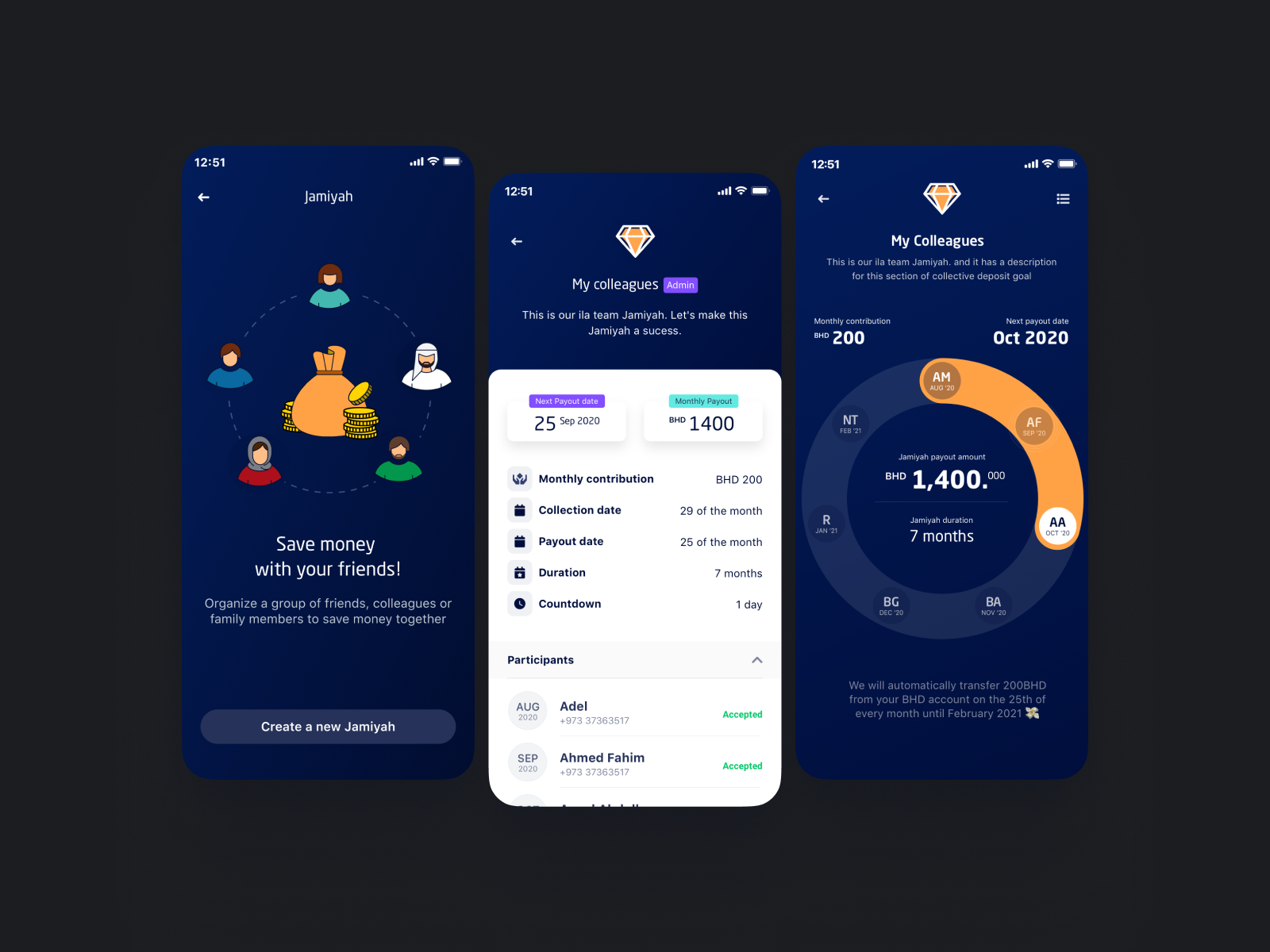
What the app added to a practice that had lived in group chats and paper notebooks was a spine: automatic collection, a guaranteed rotation, and a schedule every member can open. The rotation ring answers the only question anyone in a jamiyah ever really asks, and it answers it without anyone having to bring it up.