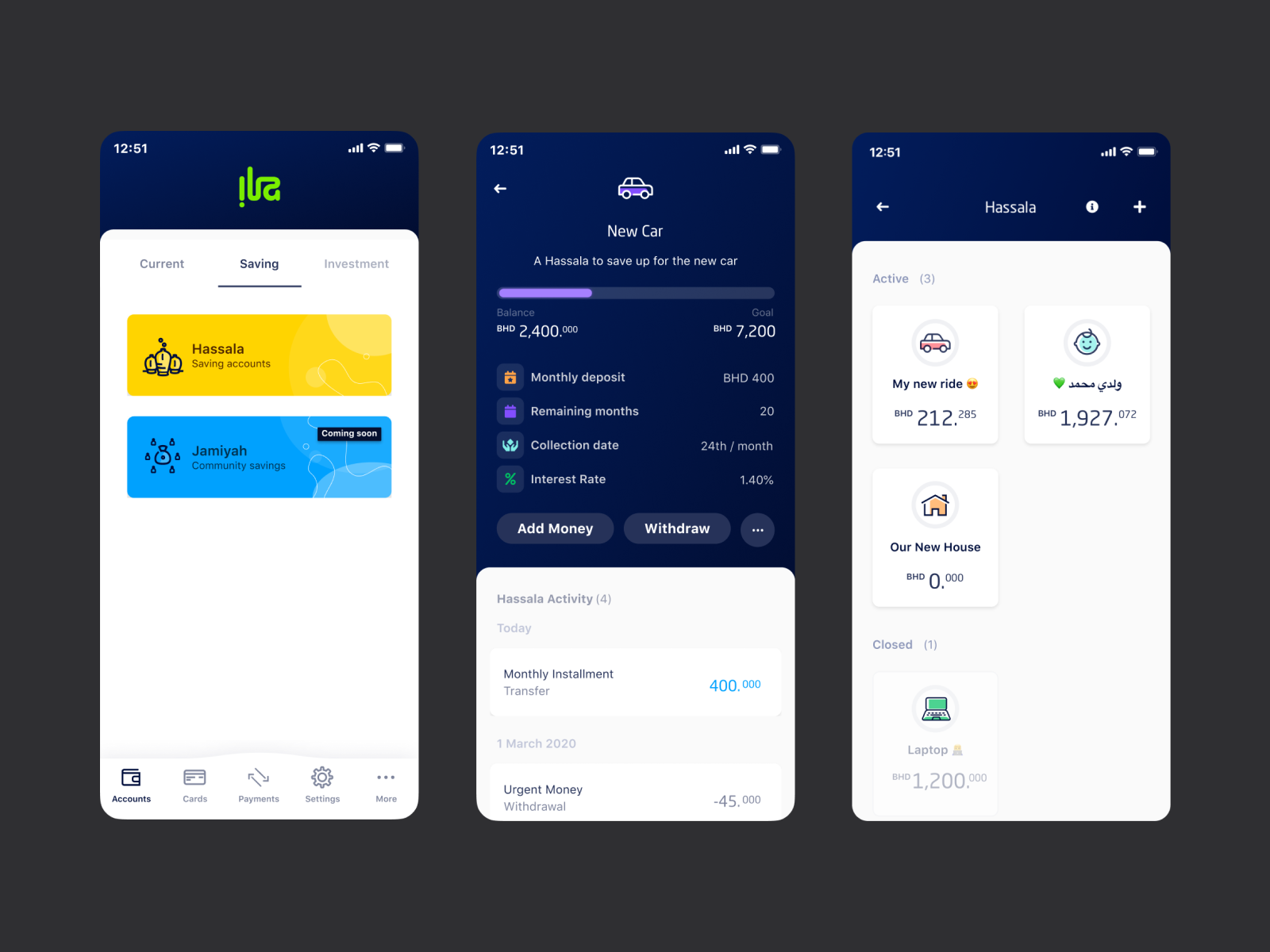
Hassala
A savings product designed for restraint, not flow, because people want their savings slightly out of reach.
Hassala is Arabic for the clay piggy bank, the kind you have to break to get into. That was the whole idea. ila Bank wanted a savings product that felt like money that reflects you, not the cold ledger of a legacy banking app. Before drawing a single screen we spent six weeks interviewing people across Bahrain about how they actually save.
Six findings came back, and the first one inverted everything a banking app is built to do.
What the research found
People deliberately make their own savings hard to reach. They hide cash, hand it to a relative, open an account at a bank they never visit. We had gone in expecting to design that friction away, and came out designing it in. Hassala makes a withdrawal feel intentional and a deposit feel effortless, which is the exact opposite of what a current account optimises for.
The rest of the research was unambiguous. Savers work toward named goals and several at once, so we built pots rather than a single balance, and showed progress as a journey rather than a number. Round-ups turn everyday spending into background saving. Pay-day is the only window that reliably converts, which made automatic pay-day transfers the default. And in a market where many people decline interest on principle, a Sharia-compliant prize draw gives them the upside that interest can’t.
Banking apps optimise for speed by default. For savings, that optimisation actively undermines the product. Designing for restraint made the difference.
Simplifying setup
The first setup screen offered too much at once and cost people about thirty seconds of confusion. Three iterations later it was eight seconds in production, and the work was all subtraction.
We coupled the deposit and duration fields, so changing one recomputes the other in real time and nobody does mental arithmetic. We split the locked Hassala from fixed deposits, once it was clear that two things that looked alike behaved differently. And the raffle finding turned out to be too big to sit inside this product as a feature, so it left home and became Al Kanz, a standalone savings experience built entirely around the prize draw.
Hassala funded fast, and it kept funding.
Those 2,700 pots were opened by 1,876 people, with travel, cash, and a house the most common goals, and daily onboarding rose about 11% after launch. The product ila shipped won its share of the bank’s Red Dot and Transform MEA recognition. The finding I keep going back to is the cheapest one in the whole project: the friction was the point.