ila Bank Cards
A card application rebuilt around who's actually applying, with controls that make trust the default.
Applying for a credit card is the moment a bank asks for the most trust and gives back the least: a wall of terms, a limit decision you don’t get to see the reasoning behind, and a card that arrives days later with no controls attached. For ila Bank we rebuilt the card experience from scratch, debit and credit, application through everyday management, and we started it the way everything at ila started, with interviews.
The three archetypes
Three ways of relating to a card came out of those interviews, and they predicted behaviour far better than any demographic did. The security-conscious cared most about what could go wrong, and routed purchases through intermediaries to limit it. Comparers had already analysed five banks before we met them and wanted the numbers stated plainly. For the status-signallers the card’s design mattered as much as its rate. One application flow had to satisfy all three without becoming three separate products.
People don’t tell you how they’ll use a card. They show you, if you ask about the last time instead of the next time.
So the limit stopped being a verdict handed down after you apply, and became something you set yourself: a slider from BHD 300 to 2,000, upgradeable later, with the figure you’ve chosen shown large and legible while you decide. The tiers state their value on the same screen rather than in the terms. A World Elite card with no annual fee and worldwide tap-and-go, and a co-branded Platinum ila × Gulf Air card for the travellers.
Card controls
The card exists as a virtual card the instant it’s approved, and the controls exist with it: freeze, hide details, change PIN, block, link currencies, order the physical card. For the security-conscious user, those sit on the front page of the card rather than three levels down in settings, which is what turns a nervous first impression into a confident one.
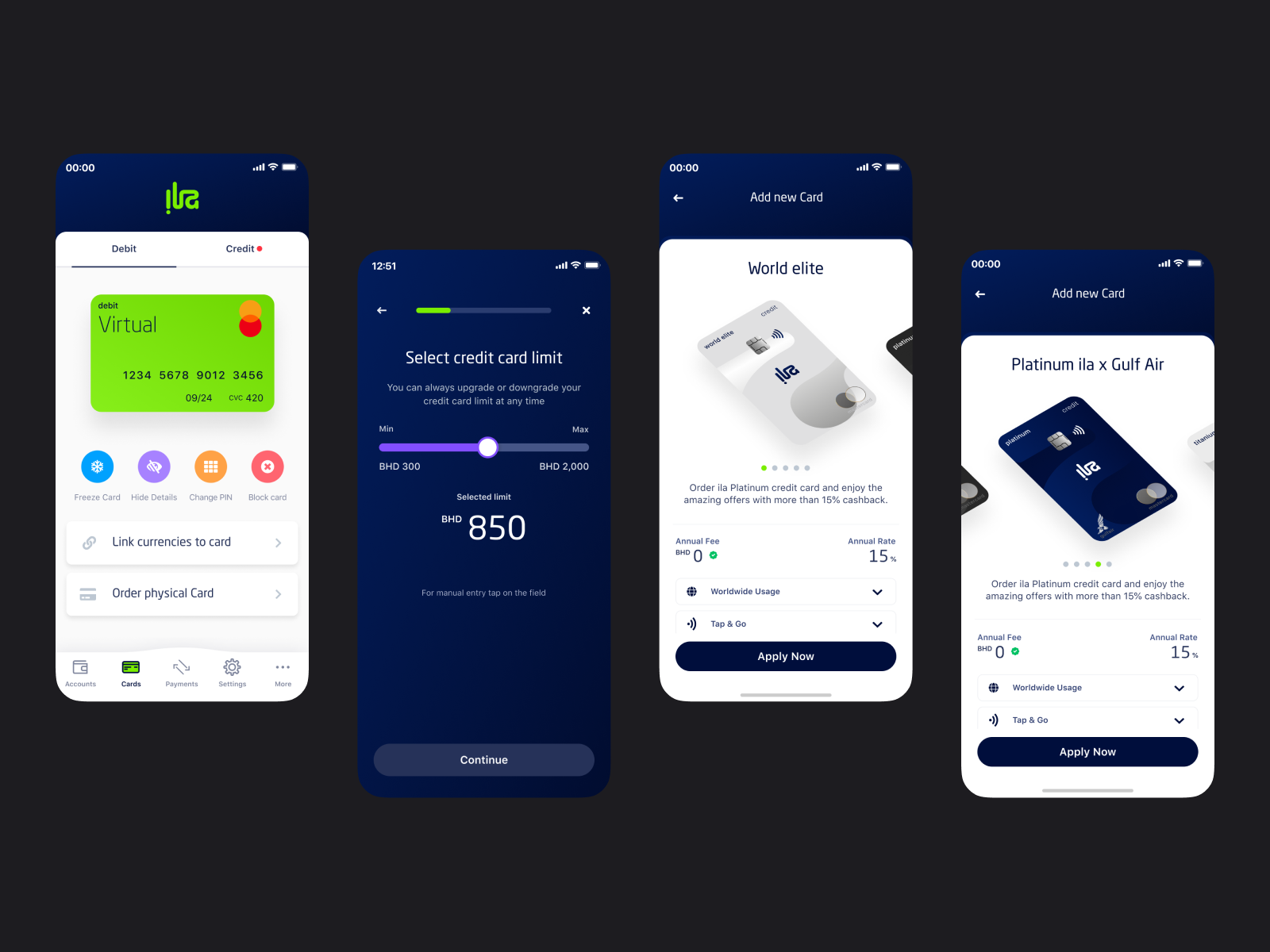
Designing for three archetypes at once sounds like a compromise and wasn’t. The comparer reads the plain numbers, the signaller gets a card worth showing, and the cautious user can freeze the card before they’ve spent a fils on it.